Table of Contents
Title: The Future of Work: Hybrid AI Offices and Remote Reality in 2026
What if your coworker is not a person but an algorithm? What if your “office” is partly virtual, partly physical, partly artificial intelligence?
Introduction: A Glimpse into Tomorrow’s Desk
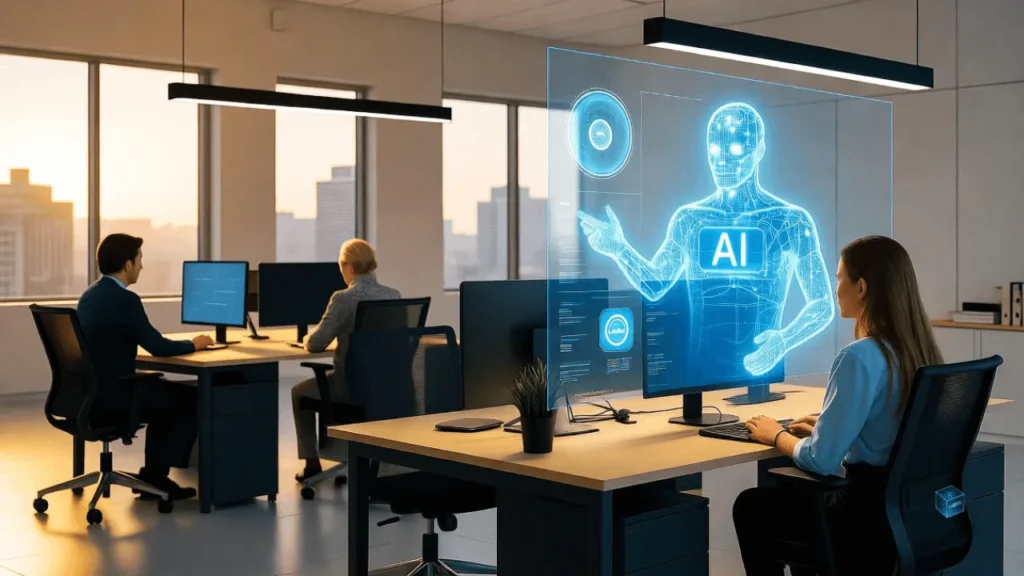
In early 2025, I visited a small startup tucked away in a converted warehouse. Its founder, Maya, told me: “On Monday I’m here, chatting with my team in person. By Wednesday I’m in Bali, wearing shorts and headset, joined by colleagues in New York and an AI agent that drafts emails for me. By Friday I meet with the AI in the office’s holo-room for feedback.” That hybrid blend—of flesh, fiber optic, and code—sounds like science fiction, yet it’s edging into our daily lives faster than we think.
As we peer ahead toward 2026, “work” will no longer mean commuting to a cubicle or simply logging onto Zoom. Instead, the future of work will be a blended dance between humans and machines, mediated by spatial computing, distributed teams, and AI collaborators. In this article, I’ll walk you through what this means—for small business owners, for writers, and for anyone curious about how meaning, craft, and work change when the lines between “real” and “virtual” blur. Along the way, I’ll also debunk one pervasive myth: that AI will simply replace human jobs. Spoiler: it won’t. At least, not in the way many fear.
Here’s what we’ll explore:
- From Hybrid to Blended: What Really Changes
- The AI Colleague: Friend, Assistant, or Rival?
- Remote Reality: VR, AR, and Spatial Presence
- Culture, Trust, and the Human Factor
- How to Prepare—Practical Steps for 2026
- Conclusion: Embracing Agency in a Shared Future
1. From Hybrid to Blended: What Really Changes
“Hybrid work” became a buzzword in the 2020s: part in-office, part remote. But by 2026, we’ll see the term evolve—or perhaps fade—into something more sophisticated: blended work. This shift is more than semantics. It’s a change in how work is constructed, not just where it happens.
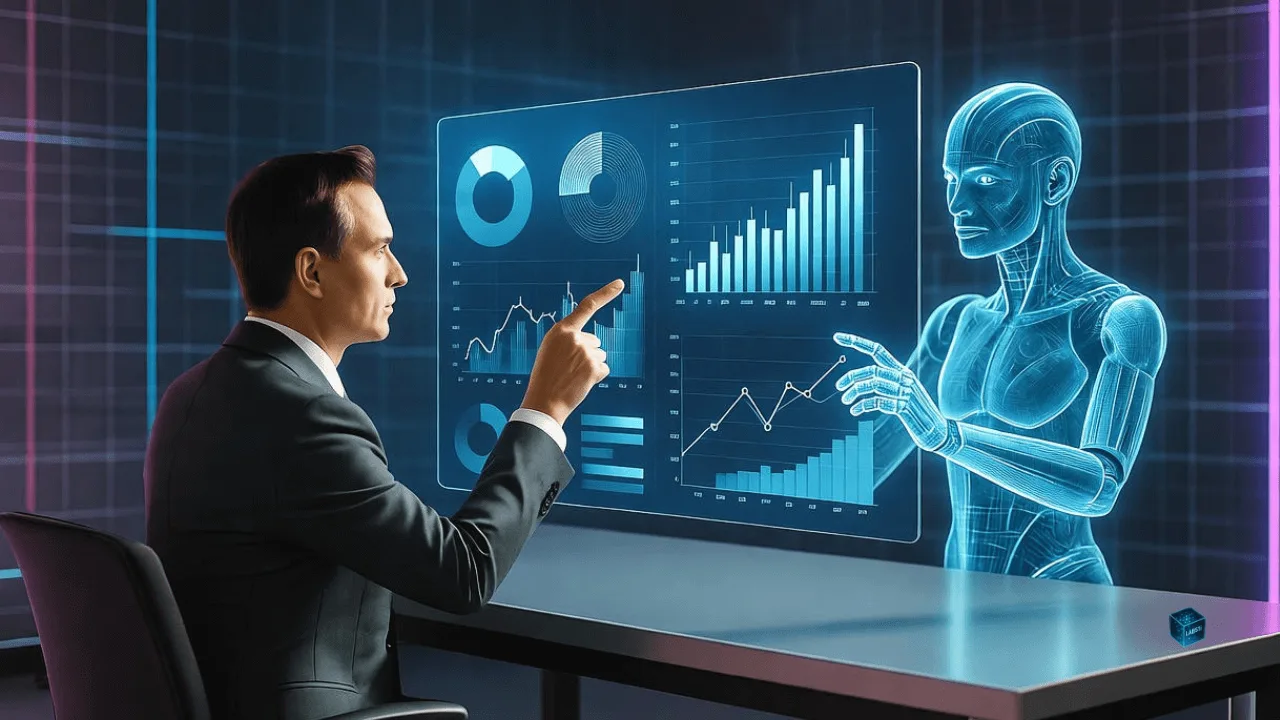
An academic provocateur argues as much: “Hybrid work is obsolete. Blended work is the future” — because work is now mediated, augmented, and entangled with AI systems. In other words, the “spaces” in which we operate will no longer be strictly human or digital—they’ll be hybridized in real time.
What shifts in blended work:
- Agency Redistribution: Some decisions and creative work will be co-authored or shaped by AI systems that suggest, correct, or optimize.
- Seamless Transitions: You’ll move from a physical room to a shared virtual hub to an AI dashboard without friction, often within the same meeting.
- Invisible Infrastructure: Algorithms will manage who’s online, allocate tasks, and detect bottlenecks—all behind the scenes.
In this paradigm, the human role moves from “doer” to “curator, mediator, and integrator.” For small business owners, that means the competitive edge is not in outworking your AI system—but in guiding it, shaping its outputs, and making the creative, ethical, and relational decisions it cannot.
2. The AI Colleague: Friend, Assistant, or Rival?
One of the most dramatic changes will be that AI shifts from being a tool you call on to a constant partner in the room. Think of it not as Autopilot, but as your co-pilot—someone (or something) that knows your habits, anticipates your needs, and intervenes when helpful. A few illustrative scenarios:

- The Meeting Scribe: During brainstorming, an AI listens, maps your ideas in visual form, suggests connections you didn’t see, and sends you an annotated mind map afterward.
- The Idea Catalyst: You sketch a plot outline for your novel; your AI suggests alternative arcs, detects genre tropes you’re echoing, or injects novel concept combinations.
- The Workload Manager: It nudges you when you’re overcommitted, flags repetitive tasks that can be automated, or offers to batch-process email responses.
But—and here’s where the myth must be debunked—AI won’t simply replace the need for human work. Rather, it will reconfigure it. Gartner and other futurists emphasize that the future isn’t humans vs. machines; it’s humans plus machines. The new battle is over who controls the narrative: the human or the algorithm?
The risk is complacency. If you let AI run unchecked, it can amplify bias, erode creativity, or misinterpret context. The trick will be to co-design boundaries: when to refuse the AI’s proposal, when to accept it, when to override.
3. Remote Reality: VR, AR, and Spatial Presence
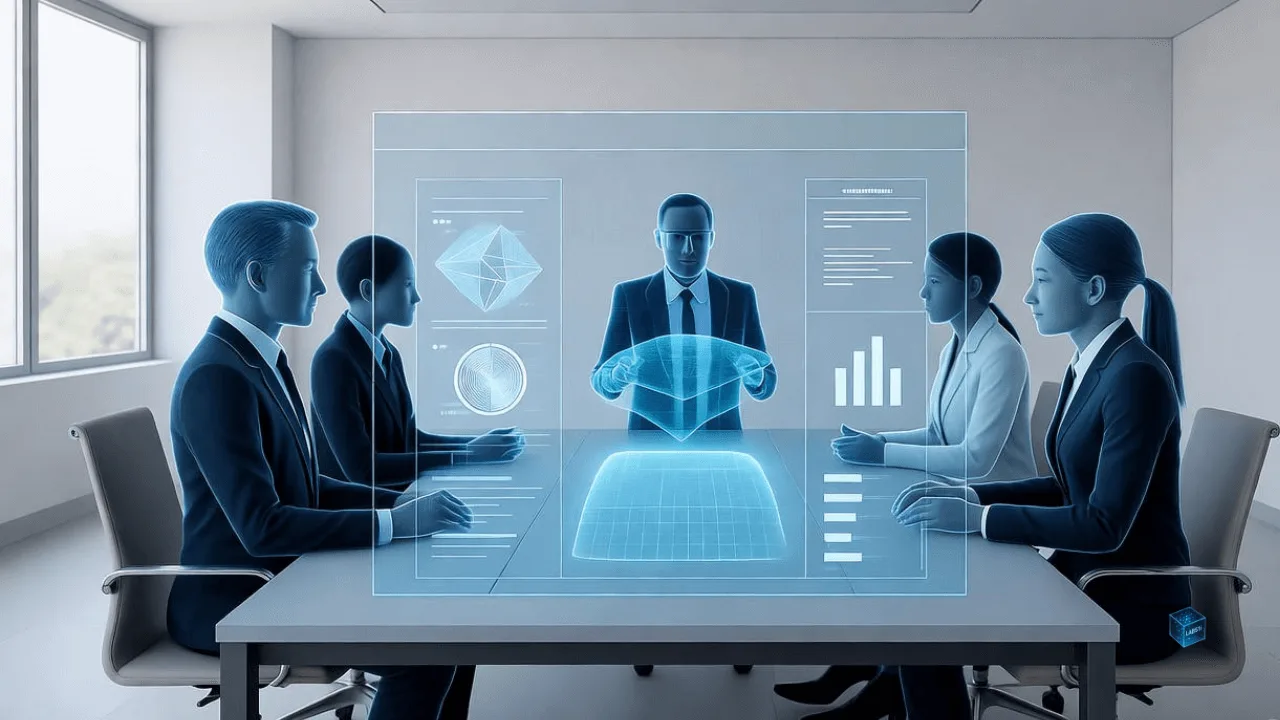
Remote work in 2026 won’t feel like squinting at a grid of Zoom tiles. Instead, you’ll often enter shared virtual “offices”, tangible in their own right.
Immersive Collaboration
VR rooms with spatial audio, AR overlays in your physical space, and shared 3D models will let designers, writers, and strategists “touch” ideas together—even if they’re halfway across the planet. Virtual “whiteboard spheres,” holographic avatars, or floating concept maps will replace flat slides and chat threads.
The advantage? You regain the kind of co-presence we lost in remote work: gestures, glances, side conversations. Tools for collaboration will “feel real.”
Blended Presence
You might sit in your physical office, wearing AR glasses. A hologram of your remote coworker appears across from you, showing you a chart or pointing to sketches. Then later, you switch to a fully virtual room for deep work.
Imagine a novelist: writing in the garden with AR overlays of plot beats, then stepping into a virtual “writing lounge” with peers where your specter-avatars sip digital tea and trade critiques.
Some remote-work trend predictions already point this way: by 2025, AR/VR-enabled collaboration is expected to become a more common fixture in hybrid settings.
4. Culture, Trust, and the Human Factor
Technology can enable—but it cannot humanize. The biggest friction that organizations will face is culture, trust, and psychological safety.

Intentional Rituals
Without the accidental hallway chats and coffees, companies must establish new rituals: virtual “water cooler” zones, AI-mediated check-ins, or deliberate “team sync” days in the physical space. These rituals sustain belonging.
Credibility in the AI Era
When your AI suggests something that’s off—say, a misinterpretation of tone or context—humans must intervene. Cultures will reward those who correct AI, teach it nuance, and restore balance. This is where empathy, judgment, and moral authority become more valuable than ever.
Boundary and Burnout
The boundary between work and rest will blur more. Every tool, every reminder, every assistant is always “on.” Leaders will need to safeguard rest, unplug times, and make space for non-algorithmic reflection. In HR forecasts for 2026, one of the emergent demands is precisely that: human-centered governance of AI and respectful work design.
5. How to Prepare: Practical Steps for 2026
Whether you run a small business, write fiction, or explore philosophical ideas, there are proactive steps you can take to thrive in this hybrid-AI future.

(a) Build an “AI Literacy” Practice
- Experiment with generative AI (e.g. prompting, chaining, evaluating outputs).
- Teach your team (even just you) to evaluate AI output critically—spotting errors, biases, and hallucinations.
- Engage in “AI code reviews” as you would peer reviews.
(b) Design Your Work in Layers
Segment your tasks into:
- Human core: What only you can do (vision, ethics, relationships, values).
- Collaborative core: Where human + AI co-work best (planning, scaffolding, iteration).
- Routine core: Automatable tasks (data cleanup, first drafts, meeting summaries).
Then assign or automate accordingly.
(c) Invest in Spatial Tools & Infrastructure
- Explore AR/VR systems—even on a small scale (Meta, Apple Vision, XR platforms).
- Look into “virtual lobby” or “holo-meeting” solutions for team sessions.
- Strengthen your tech backbone: high bandwidth, latency control, and secure identity systems.
(d) Reimagine Office Purpose
Physical space should evolve: be less for desks, more for serendipity, retreats, co-creation. Think of the office not as a factory but a studio, a lab, or a sanctuary for collective imagination.
(e) Embed Ethical and Cultural Guardrails
- Set AI transparency policies (when was this suggestion AI-generated?).
- Establish override protocols: how and when human judgment must override AI.
- Commit to rest, reflection, and periodic “no-AI days” for creative reboot.
Conclusion: Who’s Driving the Future?
Let me return to Maya, the founder I met at that warehouse startup. When I asked her if she ever worries about being replaced by her AI co-workers, she shook her head. “They enhance me,” she said. “But I still decide which stories to tell, which risks to take, which values to prioritize.” She was in command—not because she’s technologically superior, but because she retains the vision and moral compass.
The future of work in 2026 won’t belong to the fastest algorithm or the biggest institution. It will belong to those who know how to steer the blend—who can dance between human and machine, who can set the narrative, not be embedded in it.
So here’s my challenge to you:
- Try inviting an AI to co-write your next project—but refuse its suggestion on one line, just to remind yourself who’s in charge.
- Walk into your office (or virtual space) thinking: “What ritual will we need tomorrow to stay human?”
- Ask your team—or yourself: “If the AI had never existed, what boundary would you insist upon?”
Because in a hybrid AI office, the true distinction is not between “real” and “virtual,” but between agency and passivity. The future will not simply be built. It will be negotiated. And in that negotiation, it’s not about resisting AI—but about steering it.
FAQ
Frequently Asked Questions
Hybrid AI offices are the evolution of the post-pandemic hybrid workplace. Instead of just mixing remote and in-person work, they integrate AI systems that act as digital coworkers—automating workflows, scheduling meetings, summarizing discussions, and even brainstorming alongside humans. It’s like having a digital operations manager that never sleeps, yet still relies on your creative direction.
Not in the way most people fear. AI is more likely to reshape jobs rather than erase them. Routine, repetitive tasks will fade, while new roles—like AI workflow designer, human-AI editor, or ethics curator—will emerge. The most valuable workers will be those who can co-create with AI, not compete against it.
Remote work will evolve into Remote Reality—a blend of VR, AR, and AI that creates immersive, shared workspaces. Instead of staring at video tiles, you’ll join colleagues in 3D “virtual offices” or project rooms, where spatial audio, holographic avatars, and shared virtual whiteboards bring presence and collaboration back to remote life.
The toughest challenges won’t be technical—they’ll be cultural and ethical. Building trust in AI decisions, preserving human connection in virtual teams, and preventing burnout in an “always-on” world are now central to leadership. Companies that thrive will treat AI as a partner, not a dictator.
Start small but strategic: Adopt AI tools for automation and analytics. Invest in flexible infrastructure for remote collaboration. Train your team in AI literacy—understanding what AI can and can’t do. Reimagine your office as a creative hub, not a physical necessity. In short: design your workflow around adaptability, not location.
Creativity will flourish in hybrid-AI environments. Writers might co-develop stories with AI co-authors that challenge their imagination. Artists could collaborate with algorithms that generate textures or colors based on mood. Yet, the soul of creativity—intuition, empathy, and meaning—remains human. AI will extend your reach, not define your voice.
Through intentional rituals and reflection. Schedule “no-AI days.” Hold meetings about values, not just metrics. Use technology to enhance, not replace, empathy. The companies of 2026 that succeed will be the ones that treat emotional intelligence as a strategic advantage.
That it’s a binary choice—robots versus humans, office versus home, analog versus digital. The truth is far more nuanced. The future is blended: a fluid, adaptive ecosystem where the best of humanity meets the efficiency of AI. The question isn’t who wins—it’s how we choose to work together.